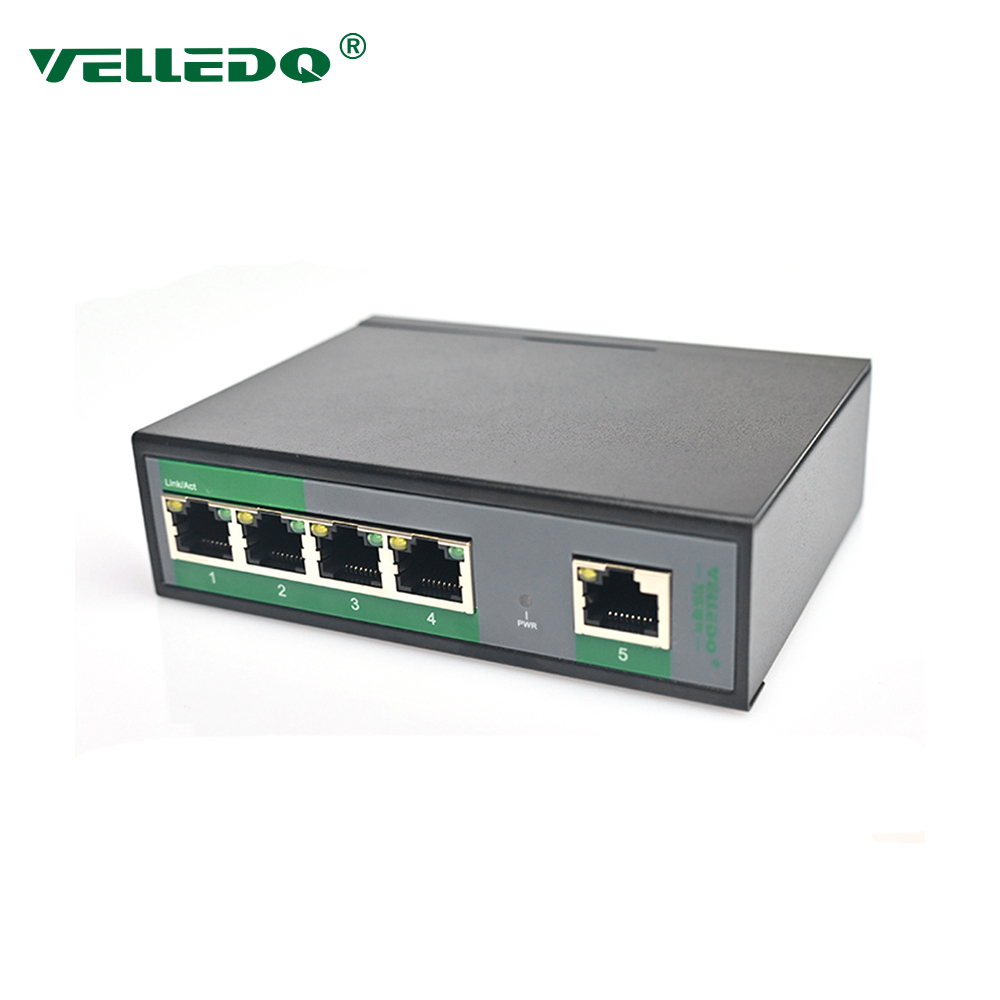
Industrial switch is also known as industrial Ethernet switch, that is, Ethernet switch equipment used in the field of industrial control, due to the use of network standards, its openness, wide application and low price, the use of transparent and unified TCP/IP protocol, Ethernet has become the main communication standard in the field of industrial control.
Industrial switches have carrier-grade performance characteristics and can withstand harsh operating environments. The product series is rich and the port configuration is flexible, which can meet the needs of various industrial fields. The product adopts a wide temperature design, the protection level is not less than IP30, and supports standard and private ring network redundancy protocols. There is no essential difference between itself and the commercial network in the data link layer, network layer, protocol layer, etc., but for the real-time needs of industrial control, industrial Ethernet switch solves technical problems such as real-time communication, network security, intrinsic safety and safety explosion-proof technology, and adopts some measures suitable for the industrial environment, such as waterproof, anti-vibration, anti-vibration, etc. Its core is still not fundamentally different from commercial Ethernet, which is the same as the difference between PC and industrial computer.
Industrial Ethernet switches are designed to meet the needs of flexible industrial applications and provide a cost-effective industrial Ethernet communication solution. The networking mode is more focused on loop design. There are single-ring and multi-ring loops, and private loop protocols designed by various manufacturers based on STP and RSTP, such as RingOn, RingOpen, FRP ring, turbo ring, and so on.
The development of hubs gave rise to a device called an unmanaged switch. It can realize the routing function of messages from one port to another port, which is more intelligent than the hub. The unmanaged switch automatically detects the network speed of each network device. In addition, it has a function called the MAC Address Table, which recognizes and remembers devices in the network. In other words, if port 2 receives a message with a specific identifier, then the switch will send all messages with that specific identifier to port 2. This intelligence avoids message conflicts and improves transmission performance, which is a huge improvement over the hub. However, unmanaged switches cannot implement any form of communication detection and redundant configuration functions.
 The next generation of Ethernet connected devices is the managed switch. Compared to hubs and unmanaged switches, managed switches have more and more complex features, and the price is much higher – usually 3 to 4 times that of an unmanaged switch.
Managed switches offer more functionality and can usually be fully configured through a network-based interface. It can automatically interact with network devices, and users can manually configure network speed and traffic control for each port. Some older devices may not be able to use automatic interaction, so manual configuration capabilities are essential.
Most managed switches usually also provide some advanced features, such as SNMP(Simple Network Management Protocol) for remote monitoring and configuration, port mapping for diagnostics, VLAN(Virtual local Area Network) for grouping network devices, priority ordering for ensuring priority messages pass through, and so on. With managed switches, redundant networks can be built. Using a ring topology,managed switches can form a ring network.
Each managed switch can automatically determine the optimal transmission path and alternate path, and automatically block the alternate path when the preferred path is interrupted.
1.Manufacturing and Factory Automation:
In the manufacturing sector, industrial Ethernet switch is instrumental in enabling the transition to smart factories and optimizing production processes. They facilitate seamless communication between machines, robots, programmable logic controllers (PLCs), and other industrial devices. Industrial Ethernet switch ensure real-time data exchange, allowing operators to monitor production processes, collect data for analysis, and make informed decisions to improve efficiency and quality. These switches also support protocols such as EtherNet/IP and PROFINET, enabling seamless integration with industrial automation systems and facilitating advanced features like remote diagnostics, predictive maintenance, and synchronized motion control.
2.Transportation and Intelligent Infrastructure:
Industrial Ethernet switch play a vital role in the transportation industry, where the efficient management of traffic, surveillance, and control systems is crucial. These switches connect traffic management systems, surveillance cameras, sensors, and control centers, enabling real-time monitoring and control of traffic conditions. Industrial Ethernet switch facilitate intelligent transportation systems, optimizing traffic flow, enhancing safety, and improving the overall efficiency of transportation networks. They also support protocols like Modbus TCP and SNMP, allowing seamless integration with diverse devices and systems for comprehensive network management.
3. Energy and Utilities:
The energy sector relies heavily on industrial switches to ensure the reliable transmission of data and control signals across power generation, distribution, and monitoring systems. Industrial Ethernet switch facilitate communication between substations, SCADA systems, smart meters, and other devices, enabling efficient grid management and ensuring the stability and reliability of power supply. These switches support protocols like DNP3 and IEC 61850, allowing seamless integration with energy automation systems and supporting advanced functionalities such as real-time monitoring, load balancing, and fault detection.
3.1Oil and Gas:
In the oil and gas industry, where operations take place in harsh and hazardous environments, industrial Ethernet switch is indispensable for reliable and secure networking. They connect critical equipment, sensors, and control systems on offshore platforms, refineries, and pipelines, providing real-time data transmission and control. Industrial switches are designed to withstand extreme temperatures, vibrations, and corrosive environments, ensuring uninterrupted operations in challenging conditions. They support protocols such as Modbus, DNP3, and SNMP, enabling integration with supervisory control and data acquisition (SCADA) systems and facilitating efficient management of remote assets.
3.2Intelligent Buildings:
Industrial Ethernet switch play a key role in creating smart buildings and intelligent infrastructure. They connect building automation systems, HVAC controls, security systems, and IoT devices, facilitating centralized control, energy management, and enhanced occupant comfort and safety. Industrial switches enable real-time monitoring and control of various building systems, allowing facility managers to optimize energy usage, monitor equipment performance, and ensure efficient operation of critical infrastructure. With support for protocols like BACnet and LonWorks, these switches enable seamless integration and interoperability among different building systems.
3.3Healthcare:
The healthcare industry is increasingly reliant on technology to improve patient care, enhance operational efficiency, and ensure critical connectivity.
Industrial switches play a crucial role in enabling reliable communication among medical devices, IoT devices, and hospital networks. They facilitate secure and efficient data transmission, supporting applications such as telemedicine, remote patient monitoring, and electronic health records. Industrial Ethernet switch with advanced security features help protect sensitive patient data and ensure compliance with regulatory requirements.
4.Mining and Heavy Industries:
Industrial switches find extensive applications in mining and heavy industries, where ruggedness, durability, and reliability are essential. These switches are designed to withstand extreme temperatures, dust, moisture, and vibrations commonly encountered in these environments. They connect mining equipment, control systems, and monitoring devices, facilitating real-time data transmission and enabling efficient resource extraction, process control, and equipment management. Industrial switches in these industries support protocols such as Modbus, EtherNet/IP, and PROFINET, enabling seamless integration and interoperability across diverse systems and devices.
Conclusion:
Industrial Ethernet switches is the backbone of modern industrial networks, providing reliable and efficient connectivity solutions across various industries. From manufacturing and transportation to energy, oil and gas, intelligent buildings, healthcare, and mining, these switches play a crucial role in driving productivity, optimizing operations, and ensuring reliable and secure communication. With their robustness, advanced features, and support for industry-specific protocols, industrial Ethernet switch empower industries to embrace digital transformation, enhance efficiency, and stay competitive in an increasingly connected world. As industries continue to evolve, industrial switches will continue to play a pivotal role in shaping the future of industrial automation and networking.